The Ninja CREAMi 7-in-1 Ice Cream Maker: A Comprehensive Guide to Creating Frozen Desserts at Home

Introduction
Homemade frozen desserts have experienced something of a renaissance in recent years, driven largely by the availability of kitchen appliances that make the process more accessible. The landscape of ice cream making has shifted considerably from the days when you needed to churn a mixture by hand or invest in expensive commercial equipment. Today’s technology offers various approaches, each with distinct advantages and limitations.
The Ninja CREAMi represents one particular approach to this category: rather than freezing and churning a traditional ice cream base, it works with pre-frozen preparations and applies pressure and shaving mechanisms to transform them into finished products. This methodology has implications for how you might use the device, the textures you can expect, and the preparation workflow required.
This guide explores what this 7-in-1 appliance does, how it operates in practical terms, what you might reasonably expect from it, and whether the approach might align with your kitchen needs and preferences. We’ll examine its capabilities, discuss various use cases, and address questions you might have before deciding whether this type of machine fits into your routine.
Understanding the Core Mechanism
Before diving into specifics, it’s helpful to understand what fundamentally distinguishes this appliance from traditional ice cream makers. Most conventional ice cream machines operate on a churning principle: they freeze a liquid or semi-liquid base gradually while continuously mixing it, which prevents large ice crystals from forming and incorporates air, resulting in a smooth, creamy texture.
The Ninja CREAMi operates differently. You prepare a base—whether that’s a smoothie mixture, sorbet mixture, or other frozen-friendly preparation—and freeze it solid in containers. The machine then extracts this frozen block and uses a process of shaving and processing to break down the frozen mass into a smooth, spoonable texture. Think of it as more similar to the way a snow cone machine transforms ice, except it’s working with frozen preparations rather than plain ice.
This distinction matters because it changes several practical aspects of the experience: preparation timing, the types of results you can achieve, texture considerations, and ingredient options. Understanding this helps set realistic expectations for what the appliance can deliver.
Key Features and Functionality
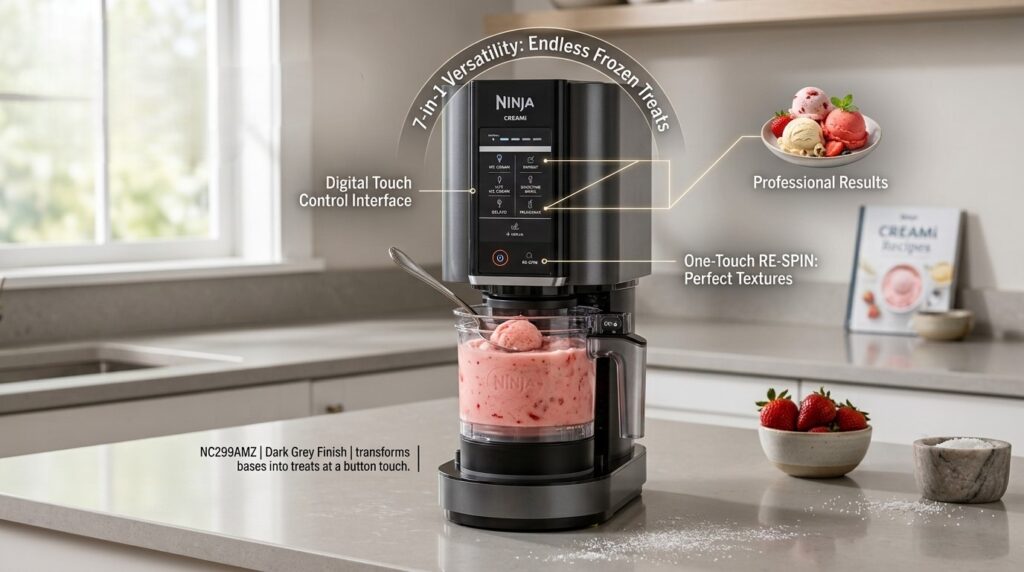
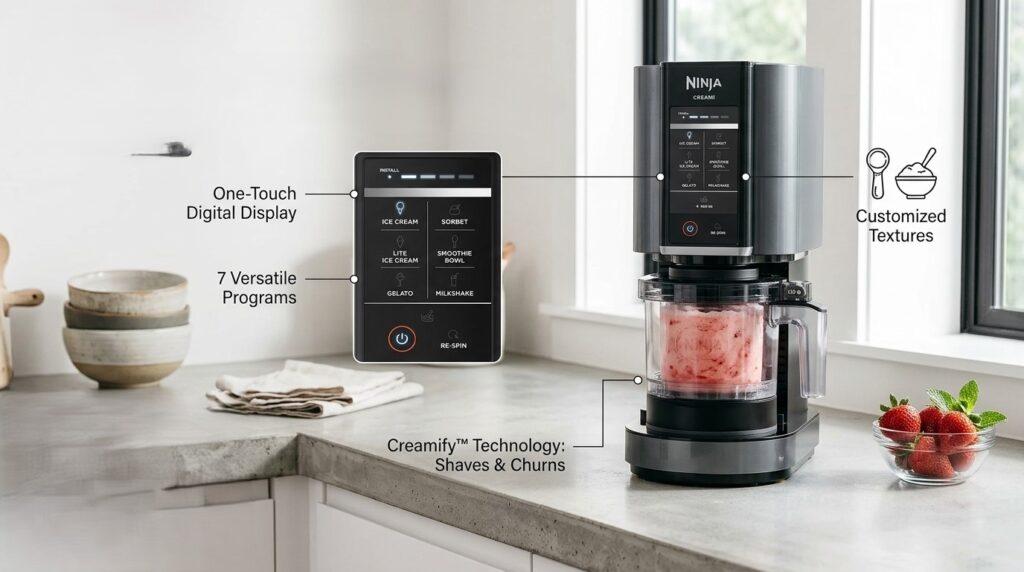
The Seven Processing Modes
The “7-in-1” designation refers to seven distinct functions the machine can perform on frozen bases. These include:
Sorbet mode processes frozen fruit juice or puree-based preparations into a smooth, spoonable texture similar to traditional sorbet. This function works particularly well with fruit-forward mixtures and delivers results with a lighter, icier quality than cream-based options.
Ice cream mode is designed for frozen preparations containing cream, milk, or other dairy components. The machine processes these bases in a way intended to yield a smoother, creamier texture than you’d get from sorbet mode, even though the underlying mechanism remains essentially the same shaving process.
Gelato mode targets a slightly different texture profile—somewhere between traditional ice cream and sorbet. This mode is useful if you want something denser and smoother than sorbet but perhaps less heavy than traditional ice cream.
Smoothie bowl mode processes frozen preparations into a thicker consistency suitable for topping with granola, nuts, or other add-ins. This creates a spoonable texture rather than a drinkable one.
Slushi mode creates a slushy consistency from partially frozen mixtures, useful if you want something between a frozen drink and sorbet.
Lite ice cream mode targets preparations without dairy or cream, focusing on transforming fruit-based or alternative-ingredient frozen bases.
Sorbet mode (sometimes listed separately) optimizes for sugar-free or lower-sugar fruit preparations.
The practical value of these different modes lies in their optimization for different base compositions. Since different ingredients freeze differently and have different densities, having distinct processing options helps the machine produce more consistent results across various preparation types.
Physical Design Considerations
The device itself requires counter space—it’s not a particularly compact appliance, though it’s designed to be vertical rather than spreading outward. The processing chamber sits at the top, where you insert frozen containers, and the motor and processing mechanisms occupy the base. This design makes it fairly visible on a countertop.
The machine requires access to standard electrical outlets and doesn’t have particularly unusual ventilation requirements. The frozen containers themselves are provided or available separately, and they’re designed to fit snugly in the machine’s chamber. The overall design prioritizes ease of use—the containers slot in without complicated alignment, and the various processing options are button-accessible.
How It Works in Practice
The Preparation Phase
The first thing to understand is that the Ninja CREAMi requires preparation time because you must freeze your base beforehand. There’s no spontaneous ice cream creation here; you need to think about what you want to create at least several hours in advance, or preferably the day before.
Typical preparation involves creating a liquid or semi-liquid base—whether that’s a smoothie mixture with fruit and yogurt, a juice blend, a cream-based custard-style mixture, or a pureed fruit preparation—and pouring it into the provided freezer containers. These containers then go into your standard freezer for several hours until completely solid.
The time required for complete freezing depends on several factors: your freezer’s temperature settings, how full the containers are, and the composition of the base. Most bases require at least 6-8 hours, though overnight freezing is more reliable and eliminates concerns about incomplete freezing.
The Processing Phase
Once frozen, you retrieve the container, insert it into the machine’s chamber, select your desired mode using the button interface, and activate the process. The machine then works to extract, shave, and process the frozen content into the final texture. The operation takes several minutes from start to finish. Most batches yield enough for multiple servings, though the exact amount depends on your starting base volume and the density of your preparation.
Output and Texture
The results you get depend significantly on your base preparation. A high-dairy base will produce something smoother and more ice cream-like. A high-water base (like juice) will produce something more granular or icy. Adding ingredients like coconut milk, condensed milk, or other fat-containing components affects the final texture and mouthfeel.
The machine doesn’t produce the exact texture of traditionally churned ice cream, primarily because that texture comes from the incorporation of air during the churning process and the specific way fat and ice crystals interact when frozen slowly over time. The Ninja CREAMi’s approach creates a different—though still quite pleasant—texture profile that some people prefer and others find noticeably different from what they expected.
Practical Usage Ideas
Health-Conscious Applications
One significant appeal of the Ninja CREAMi is the ability to control everything that goes into your frozen creation. If you’re interested in creating frozen desserts with specific nutritional profiles, the base preparation stage gives you complete control over ingredients.
You might create smoothie bowls using frozen blended fruit, Greek yogurt, and a minimal amount of added sweetener, then process them into a spoonable consistency for topping. You could prepare sorbet bases using fruit juice and nothing else, creating pure fruit-based frozen desserts. The ability to avoid stabilizers, gums, and additives that commercial products often require appeals to people with specific dietary preferences or restrictions.
Preparing bases with protein powder, non-dairy milk alternatives, or specific nutrient focuses is entirely possible. The machine itself doesn’t care about the nutritional composition of the base—it simply processes whatever frozen preparation you provide into the selected texture.
Indulgent and Creative Preparations
The machine also handles richer preparations well. A base containing heavy cream, egg yolks, and significant sugar amounts will process into something quite satisfying and dessert-like. You can add mix-ins during base preparation—crushed cookies, chocolate pieces, or candy items that won’t interfere with the freezing process. You can create alcohol-infused bases for adult-oriented frozen creations, since alcohol has different freezing properties than water.
Experimentation is genuinely part of the appeal here. The base preparation stage is where creativity happens, and the machine simply executes the chosen preparation into a specific texture profile.
Seasonal and Ingredient-Driven Uses
During berry season, you can take advantage of fresh, affordable fruit to create bases for processing throughout the year. Frozen bases keep well, allowing you to prepare several containers when ingredients are abundant and then process them as desired. This approach can feel more economical and also ensures you’re using the peak-season quality ingredients.
You might also create themed batches—summer bases using tropical fruits, fall variations with pumpkin or apple preparations, winter offerings with chocolate and spice, and spring iterations featuring lighter fruits and florals. The freezer-friendly nature of prepared bases makes this seasonal approach quite practical.
Who This Appliance Suits
Ideal User Profiles
The Ninja CREAMi makes the most sense for people who enjoy frozen desserts enough to prepare them intentionally but don’t necessarily want to commit to traditional ice cream making with its churning requirements and specific timing constraints.
Households with dietary preferences or restrictions that make commercial ice cream less suitable often find good value here. People avoiding certain ingredients, practicing specific eating approaches, or managing allergies appreciate the ingredient transparency and control.
Households where multiple people enjoy frozen desserts but have different preferences benefit from the ability to prepare multiple distinct bases and process them as needed. Parents of children who enjoy frozen treats might appreciate the ability to create portions with controlled sugar amounts or with fruit as primary components.
People who simply enjoy the process of experimentation and trying new flavor combinations find the mechanical separation of preparation and processing to be empowering rather than limiting.
Less Ideal Scenarios
If you prefer spontaneous ice cream creation without advance preparation, the freezing time requirement makes this less suitable. The appliance requires planning; it’s not a solution for last-minute dessert needs.
Those who strongly prefer the specific texture of traditionally churned ice cream with its characteristic smoothness and air incorporation might find the Ninja CREAMi’s output noticeably different, even if pleasant.
Extremely space-limited kitchens might hesitate at the countertop footprint, though this varies based on your specific situation.
If you rarely use kitchen appliances or prefer absolute minimal kitchen clutter, adding another device requires a genuine use case to justify the space.
Important Considerations Before Use
Preparation Quality Matters Significantly
The appliance can only work with what you provide. A poorly designed base will produce a disappointing result regardless of how well the machine operates. Bases that are too dilute freeze into something too icy; bases with insufficient fat or cream result in grainier textures; bases without adequate sweetening produce less satisfying results.
Learning what base compositions yield satisfying results in your particular freezer requires some experimentation. The composition that works beautifully in one freezer might behave differently in another freezer at different temperature settings. This is part of the learning curve.
Freezer Space and Planning
The prepared bases require freezer space during their freezing period. If you have a small freezer or it’s already crowded, this might be restrictive. Planning ahead—preparing bases during times when you won’t be storing other large items—helps manage this practical constraint.
Cleaning and Maintenance
The machine’s processing components require cleaning after use. The removable parts can typically be hand-washed, though specific components may have care instructions. The overall maintenance isn’t particularly demanding compared to many kitchen appliances, but it’s not entirely maintenance-free either.
Container Investment
You’ll need the specialized containers designed for the machine. While the device typically comes with some containers, having extras allows you to prepare multiple bases simultaneously, so you’re not waiting for one container to freeze before preparing another.
Noise Level
The machine produces noise during operation—not unusually so for kitchen appliances, but noticeable. This is worth considering if you have concerns about kitchen noise or if you operate the machine during times when quietness matters.
Comparing Frozen Dessert Preparation Methods
Understanding how the Ninja CREAMi approach compares to other methods helps contextualize whether it suits your needs. Each approach has genuine advantages and limitations.
Versus Traditional Churning Machines
Traditional ice cream makers with electric churns freeze a base gradually while mixing it. This produces results with incorporated air and a characteristically smooth texture. The process requires more active time—you’re working with liquid or semi-liquid bases and managing temperatures. The entire process from base to finished product typically takes several hours. However, the resulting texture is often preferred by ice cream enthusiasts, particularly for rich, custard-based preparations.
The Ninja CREAMi’s advantage here is convenience—most of the time is passive freezing time rather than active machine operation. The Ninja CREAMi process itself is faster. The disadvantage is textural—you won’t achieve the exact quality that slow churning produces, and if that specific texture is important to you, the Ninja CREAMi’s results might disappoint.
Versus Manual or Hand-Cranked Methods
Manual ice cream making involves freezing a base while stirring it periodically, or using hand-cranked equipment. This is labor-intensive and produces variable results depending on how diligently you stir. The Ninja CREAMi wins decisively on convenience and consistency. Few people compare these methods seriously anymore; the machine approach simply offers superior outcomes with less effort.
Versus Commercial Products
Store-bought ice cream, gelato, and sorbet offer consistency and convenience—you purchase the finished product, and it’s ready to consume. The Ninja CREAMi requires advance planning and preparation time. However, you gain ingredient control, the ability to customize flavors precisely, and typically lower per-serving costs if you make it regularly. Commercial products come in set flavors; the Ninja CREAMi lets you create infinite variations. This is a trade-off between convenience and customization.
Versus Blended Frozen Preparations
You can create frozen treats simply by freezing fruit and blending it with your high-power blender. This is extremely simple and requires no special equipment. However, it produces a specific texture (typically thick and icy) and has limitations for bases that don’t blend well or for creating specific textures like sorbet or gelato. The Ninja CREAMi optimizes for specific texture outcomes that blending alone can’t reliably achieve.
Frequently Asked Questions
Can I use any container to freeze my base, or do I need the proprietary containers?
The machine is specifically designed to work with its specialized containers, which fit the machine’s chamber and processing mechanisms. Using other containers would require manual transfer and removal, defeating the purpose of the system. The design necessitates the specific containers.
How long does the processing actually take?
Most batches take between 5-15 minutes from insertion to finished product, depending on the base consistency and which processing mode you select. It’s not instantaneous, but it’s faster than traditional churning would be for equivalent volume.
Can I add mix-ins after processing?
You can certainly fold or mix add-ins into the finished product immediately after processing, though you need to work reasonably quickly before it melts. Adding ingredients to the base before freezing is often more practical.
What’s the texture actually like compared to ice cream I’ve had before?
This depends on your base preparation and what ice cream you’re comparing to. Bases with high dairy and fat content will produce something reasonably similar to softer commercial ice creams, though not identically smooth. The texture is generally described as somewhere between sorbet and ice cream, with a slightly icier or grainier quality than slow-churned ice cream but smoother than sorbet. Expectations matter here—if you’re expecting traditional ice cream texture, you might need to adjust that expectation. If you approach it as its own category, many people find it quite satisfying.
How much product do I get from one batch?
This depends on your container size and how full you fill it before freezing, as well as how much processing and shaving occurs during operation. Most standard preparations yield enough for 4-6 servings, though this varies.
Can I make dairy-free or vegan bases?
Yes. Using non-dairy milk, coconut cream, or other dairy-free components works fine. The machine doesn’t care about the base composition. Results will differ from dairy-based preparations due to different freezing properties, but many people achieve satisfying results with non-dairy bases.
What’s the noise level?
The machine produces noticeable noise during operation—comparable to a typical blender. It’s not whisper-quiet, so using it while someone’s sleeping nearby might be inconsiderate, but it’s not unusually loud for kitchen appliances.
Can I use the machine with juice straight from the bottle?
Juice freezes, but it will be quite icy and grainy compared to preparations with added fat or cream. You can process pure juice, but the result is more like a frozen juice bar than traditional sorbet. Adding a small amount of sweetener, gelatin, or other ingredients to juice bases improves the texture.
Does everything freeze solid the same way?
No. Different base compositions freeze at different rates and to different solidity levels. Alcohol freezes differently than water; different fats behave differently; sugar content affects freezing point. Experimentation helps you understand what works best in your specific freezer.
What if my frozen base is too hard to process?
If your base freezes so solid that the machine struggles, you can let it sit at room temperature for a few minutes to soften slightly before processing. However, if you’re consistently having this issue, your base composition might need adjustment—less water content or different ingredients that freeze to a more processable consistency.
Can I make slushies or partially-frozen drinks?
Yes. This is specifically what the slushi mode is designed for. You freeze a preparation partially (rather than rock solid) and process it to create a slushy consistency. This requires somewhat different preparation and freezing approaches than solid-base methods.
Conclusion
The Ninja CREAMi 7-in-1 represents a specific approach to home frozen dessert preparation: one that separates ingredient preparation from processing into texture, that prioritizes convenience and ingredient control, and that requires advance planning but delivers flexibility and customization in return.
It’s not a replacement for traditional ice cream making, nor is it intended to be. Rather, it’s a distinct method with genuine advantages for people whose priorities align with what it offers. The appeal lies not in competing with expensive commercial equipment or achieving textures that aren’t its design objective, but in making a particular style of preparation accessible, consistent, and feasible within a typical home kitchen setup.
Understanding what the machine actually does—processing frozen preparations into specific textures rather than churning liquid bases—helps set realistic expectations. The quality of results depends significantly on thoughtful base preparation, which puts some responsibility on the user to experiment and learn what works in their specific situation.
For households interested in creating frozen desserts with controlled ingredients, enjoying the experimentation of different flavor combinations, or wanting customization options that commercial products don’t offer, this appliance provides a practical avenue. For those prioritizing ease and convenience with minimal forethought, or those with specific textural preferences tied to traditional ice cream making, it might not fulfill those particular needs.
The ultimate decision depends on your specific situation: how much you enjoy frozen desserts, how much advance planning suits your lifestyle, whether ingredient control matters significantly to you, and how much kitchen space and investment you’re willing to allocate to a specialized appliance.