Electric Burr Coffee Grinders: A Guide to Getting the Most Out of Your Coffee Preparation

Introduction
The difference between a great cup of coffee and a mediocre one often comes down to factors that many people overlook. Grind quality stands among the most important of these. When you start paying attention to how your coffee beans are ground, you begin to understand why coffee enthusiasts spend considerable time researching grinders before making a purchase.
Electric burr grinders represent a significant step forward from blade grinders for anyone serious about their morning brew. Unlike blade grinders, which essentially chop beans into inconsistent particles, burr grinders crush beans between two surfaces to produce uniform pieces. This consistency matters because it directly affects how water extracts flavor compounds from the grounds during brewing.
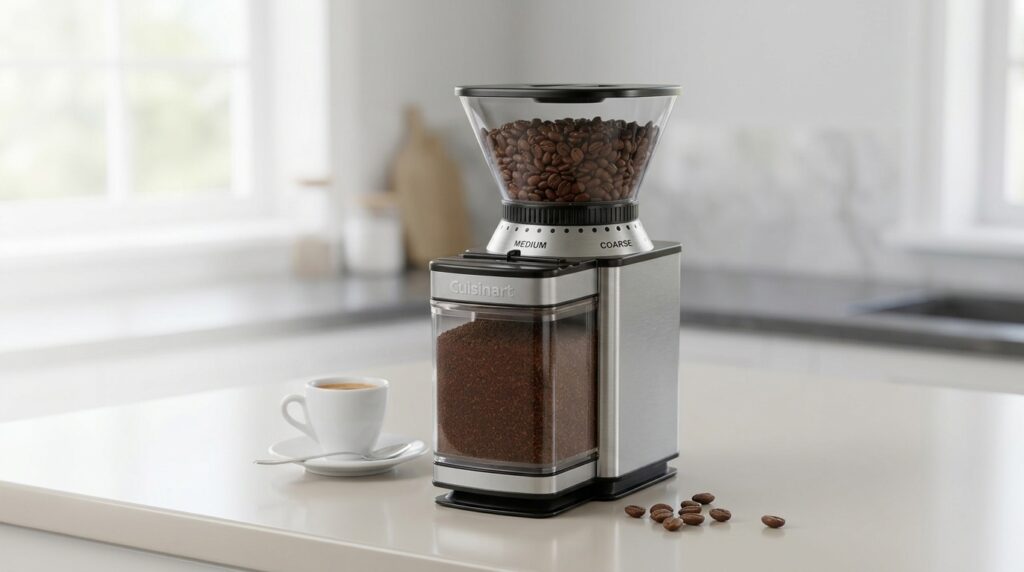
The Cuisinart DBM-8P1 falls into the entry-to-mid-range burr grinder category, offering a straightforward approach to grinding coffee at home. Whether you’re someone who’s been buying pre-ground coffee and wants to explore whole beans for the first time, or you’re upgrading from a less capable grinder, understanding what this machine does and doesn’t do can help you make an informed decision about whether it fits your needs.
What Makes a Burr Grinder Different
Before discussing this specific model, it’s worth understanding the fundamental difference between burr and blade grinders.
Blade grinders use rotating metal blades that chop beans into pieces. The problem with this approach is that you get inconsistent particle sizes. Some pieces end up very fine, while others remain relatively large. When you brew coffee with inconsistently ground beans, the smaller particles over-extract (becoming bitter and harsh), while larger particles under-extract (tasting weak and sour). This uneven extraction explains why pre-ground coffee from blade grinders often tastes thin or one-dimensional.
Burr grinders use two surfaces—each called a burr—positioned at a specific distance apart. One burr remains stationary while the other rotates, crushing beans between them. The space between the burrs determines the final grind size. Adjust that space, and you adjust your grind. This design produces much more uniform particle sizes, which leads to more consistent extraction during brewing.
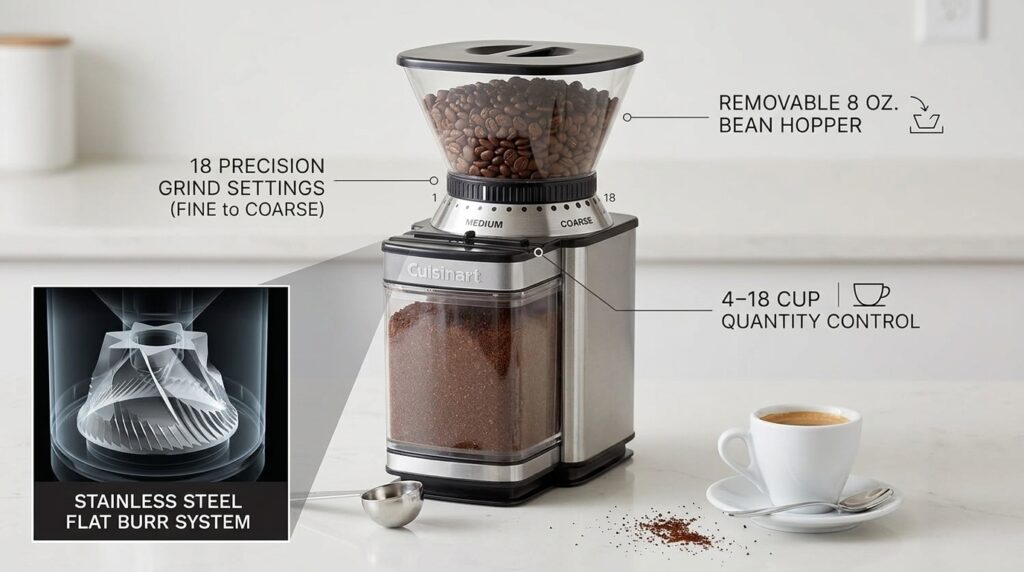
The Cuisinart model uses flat burrs, as opposed to conical burrs. Flat burrs consist of two flat discs with ridges facing each other. This design is straightforward and effective for producing consistent grounds. Some people prefer conical burrs for slightly different reasons, but flat burrs remain popular for good reason—they’re durable, relatively easy to clean, and perform well across different grind sizes.
Key Features and What They Mean for You
The 18-Position Selector
The grinder includes an 18-position selector that adjusts how fine or coarse the grounds become. This range gives you flexibility to experiment with different brewing methods.
For espresso, which requires very fine grounds to create enough resistance for proper pressure buildup, you’d select toward the finest end of the range. For French press brewing, which needs coarser grounds to prevent particles from slipping through the mesh filter, you’d move toward the coarser end. Drip coffee makers typically call for a medium grind, landing somewhere in the middle of those 18 positions.
What the 18 positions actually represent is good differentiation for most home brewers. You won’t typically need 50 different settings. Most people find themselves using maybe 4 to 6 positions regularly—one for espresso, one for pour-over, one for French press, and so forth. Having 18 gives you room to fine-tune without offering so many options that adjustment becomes paralyzing.
The 8-Ounce Bean Hopper
The hopper holds up to 8 ounces of whole beans, which translates to roughly enough beans for 20-30 cups of coffee depending on how strong you prefer it and how much water you actually use per cup.
This size represents a practical middle ground. It’s large enough that you won’t need to refill constantly if you drink a couple of cups daily, yet small enough that beans don’t sit around for extended periods. Coffee starts losing freshness and flavor complexity once beans are ground, but whole beans also gradually deteriorate over time, especially if exposed to light, heat, or humidity. A smaller hopper encourages fresher coffee overall because your beans spend less time in storage.
The removeable hopper matters for cleanliness and maintenance. Over time, bean oils can build up inside the hopper, potentially affecting flavor. Being able to take the hopper out and clean it properly—rather than trying to brush out the interior of a fixed container—makes keeping your grinder in good condition much more practical.
Capacity Reference: 4-18 Cups
The “4-18 cups” reference indicates the grinder’s capacity for different brewing purposes. Some brewing methods extract more efficiently than others. A pour-over system might produce a decent cup from a smaller amount of grounds, while an espresso machine requires a specific amount of finely ground coffee to function properly.
This range simply shows that the amount of grounds this grinder produces in one session can serve different purposes. It’s not claiming that you’ll grind enough for 18 cups in one run; rather, the grounds produced can be used to brew anywhere from 4 to 18 cups depending on your method and preferences.
How to Use an Electric Burr Grinder Effectively
Understanding how to use a grinder properly can significantly impact your results.
Selecting Your Grind Size
Start by understanding what grind size your chosen brewing method requires. Pour-over systems, French presses, espresso machines, Moka pots, and Turkish coffee preparation each have different requirements. If you’re new to this, the instruction manual typically includes guidance, and most brewing equipment comes with recommendations.
When you’re adjusting grind size, make small changes. Moving from setting 7 to setting 8 is less dramatic than jumping from 7 to 12. Small adjustments let you dial in your perfect grind for a particular brewing method and bean type.
Filling and Operating
Pour whole beans into the hopper until full, then select your desired grind setting. Press the button or lever and hold it down while grinding. Most electric grinders shut off automatically once you release the button, though some will run until you actively turn them off—check your model’s specific instructions.
For consistent results, grind immediately before brewing. This minimizes oxidation and flavor loss. If you must grind ahead of time, store the grounds in an airtight container, though they’ll be fresher if used within 30 minutes of grinding.
Finding Your Coffee Bean Preferences
Grinding your own beans opens up possibilities for exploring different origins, roast levels, and flavor profiles. Single-origin coffees from specific regions often display unique characteristics—Ethiopian beans might show fruity notes, while Kenyan beans often present more wine-like qualities. Blends combine beans from different regions to create balanced flavor profiles.
Roast level also affects how a bean tastes. Light roasts retain more of the bean’s origin characteristics. Dark roasts often taste bolder and more bitter. Medium roasts fall somewhere in between. Grinding beans yourself lets you explore these differences rather than being limited to whatever’s been pre-ground and sitting in store bins.
Maintenance and Cleaning
Regular cleaning keeps your grinder functioning optimally. The removeable hopper can be washed with water and dried thoroughly before reattaching. For the grinding chamber itself, most manufacturers recommend running grinder cleaner tablets through the grinder periodically to remove oil buildup. Never use water inside the grinding chamber.
Between deep cleans, a soft brush can remove residual grounds from the hopper and the area around the burrs. This prevents old grounds from mixing with fresh ones and affecting flavor.
Who Might Consider This Grinder
Coffee Enthusiasts Upgrading from Blade Grinders
If you’ve been using a blade grinder or buying pre-ground coffee, an electric burr grinder represents a noticeable quality improvement. You’ll likely notice immediately that your coffee tastes more balanced and nuanced. The consistency of the grind directly translates to better-tasting coffee.
Daily Coffee Drinkers with Limited Counter Space
The footprint of this grinder is moderate—not so large that it dominates your counter, but substantial enough to sit stably during operation. For someone who grinds coffee daily but doesn’t have excessive kitchen space, this strikes a reasonable balance.
People Using Multiple Brewing Methods
If you switch between a pour-over one day and a French press the next, adjustability matters. The 18-position selector gives you flexibility to dial in different grind sizes for different methods without needing multiple grinders.
Those New to Whole-Bean Coffee
For someone just starting to explore whole beans and realizing they need a grinder, this model offers reliable functionality without overwhelming complexity. The straightforward operation and clear grind settings make it accessible to beginners.
Budget-Conscious Home Brewers
Entry-to-mid-range grinders offer substantially better performance than blade grinders at a fraction of what high-end models cost. If you’re looking for quality grind consistency without premium pricing, this category of equipment addresses that need effectively.
Important Considerations Before Purchasing
Noise Level
Electric burr grinders produce noise during operation—this is unavoidable when a motor is spinning burrs at high speed. Different grinder models and designs vary in how loud they operate. If you live in a space where noise is a concern, or if you grind coffee early in the morning when others are sleeping, noise level is worth researching. Burr grinders are generally louder than blade grinders, though the sound is different—a grinding sound rather than a chopping sound.
Heat Generation
The grinding process generates heat, which can affect bean flavor if grinding continues too long. For this reason, avoid grinding very large quantities continuously. Grinding in reasonable batches, then pausing to allow the mechanism to cool slightly, helps preserve flavor. For most home use, this isn’t a practical concern—you’re grinding relatively small amounts for immediate use, not large commercial quantities.
Consistency Across Grind Sizes
Burr grinders perform most consistently in their middle range. The finest grind settings and coarsest settings might show slightly more variation compared to medium settings. If you primarily use a grinder for one specific method—say, espresso exclusively—this isn’t an issue. If you’re constantly switching between very fine and very coarse, expect slightly less uniformity at the extremes.
Counter Space and Storage
This grinder needs dedicated space on your counter or a cabinet large enough to store it. Unlike some small appliances, an electric grinder typically isn’t something you store away after each use—most people keep it accessible for daily grinding. Consider whether you have that space available.
Electricity and Cord
The grinder requires an electrical outlet nearby. If your coffee station is far from outlets, this could be a limitation. The cord length determines how far from the outlet you can place the unit.
Learning Curve
While burr grinders are simpler to use than some coffee equipment, there is a minor learning curve. You need to learn what grind size works for your brewing method, understand how to adjust the setting, and develop consistent technique. This isn’t complicated, but it’s slightly different from using a blade grinder or buying pre-ground coffee.
How Burr Grinders Compare to Other Options
Blade Grinders
Blade grinders are less expensive and simpler in design. However, they produce inconsistent particle sizes, leading to less balanced extraction during brewing. Most coffee professionals recommend moving beyond blade grinders if you’re invested in coffee quality. The difference in taste is genuine and noticeable.
Manual/Hand Grinders
Manual grinders require physical effort but produce excellent consistency and are portable. Some people enjoy the tactile experience and mindfulness aspect of hand grinding. The trade-off is that they take considerably longer to produce grounds. For someone making multiple cups daily, the time investment becomes significant.
High-End Burr Grinders
Premium grinders cost substantially more but may offer advantages like better heat management, more precise grind adjustments, quieter operation, or specific designs optimized for particular brewing methods. For many home brewers, the practical differences become less significant at higher price points—you’re paying for incremental improvements rather than dramatic changes.
Grinder Burrs: Flat vs. Conical
Flat burrs and conical burrs each have advocates. Flat burrs are typically easier to clean and perform consistently well across different grind sizes. Conical burrs may offer slightly different texture characteristics and some prefer their design. For most purposes, both work effectively. The choice between them isn’t as important as choosing between burr and blade grinding.
Frequently Asked Questions
How long does grinding take? A typical 8-ounce hopper full of beans takes roughly 30-60 seconds to grind, depending on the grind size you select. Finer grinds take longer than coarse ones because the burrs need to crush the beans into smaller particles.
Can I grind different types of beans without cleaning between them? Technically, you can switch bean types without cleaning, though some flavor from the previous beans might linger. If you’re switching from a dark roast to a light roast, the residual flavors might affect your new coffee. Many people do a quick clean between very different bean types to ensure clear flavor.
What happens if I don’t grind immediately before brewing? Ground coffee begins losing volatile aromatic compounds once exposed to air. Within 30 minutes, this loss becomes noticeable. After several hours, the flavor is noticeably flatter. This is why fresh grinding produces fresher-tasting coffee. That said, grounds don’t become unusable immediately—they just gradually lose their best qualities.
Do I need to grind the entire hopper each time? No. You can grind partial amounts. The grinder works fine whether full or partially filled. Many people grind only what they need for immediate brewing.
What’s the difference between a “cup” measurement for brewing versus the grinder’s output? Coffee cup measurements vary. A standard US cup is 8 ounces, but coffee cups come in many sizes. The “4-18 cups” reference is approximate—it’s indicating what amount of brewed coffee the ground output can produce, not specific volume measurements.
Can I adjust the grind while the motor is running? No, you should never adjust the grind setting while the grinder is operating. Always stop the grinder first, then adjust the setting before grinding again. Attempting to adjust while grinding can damage the mechanism.
How often should I clean the grinder? For regular home use, a basic cleaning once weekly is typically sufficient. A deeper clean using grinder cleaner tablets monthly helps remove accumulated oils. If you notice flavor changes or the grinder sounds different, cleaning is definitely warranted.
What beans work best in a burr grinder? Any coffee beans work in a burr grinder. The advantage of burr grinding applies equally to all bean types—the uniform grind size improves extraction regardless of origin or roast level.
Is this grinder suitable for espresso? This grinder can produce fine enough grounds for espresso brewing. However, espresso machines have specific requirements around grind consistency and texture. This mid-range grinder can work for espresso, though espresso enthusiasts often prefer grinders specifically designed with espresso in mind.
How loud is it compared to other grinders? Burr grinders are inherently louder than blade grinders. Different models vary in absolute noise level, but the grinding sound is unavoidable. If noise sensitivity is a concern, researching specific decibel levels or reading about user experiences with particular models is worthwhile.
Making the Most of Whole Bean Coffee
Switching to grinding your own beans opens possibilities beyond just using the same coffee beans you might have bought pre-ground.
Exploring Single-Origin Coffees Once you’re grinding your own, exploring single-origin coffees becomes practical. These beans come from specific regions or even specific farms. Each offers different flavor characteristics. An Ethiopian Yirgacheffe tastes notably different from a Brazilian Santos, which differs from a Kenyan AA. Grinding your own removes the barrier of finding these specialty beans pre-ground.
Understanding Roast Dates Most specialty coffee comes with roast dates printed on the bag. Beans are at their peak flavor roughly 5-14 days after roasting. After several weeks, they gradually diminish. When you grind your own, you can choose fresh beans and enjoy them at their best. Pre-ground coffee from stores often sits for unknown lengths of time before purchase.
Adjusting to Your Preference As you experiment with different beans and grind sizes, you’ll develop preferences for what you like. Some people prefer the clarity of lighter roasts, while others prefer the boldness of darker roasts. Some love fruity Ethiopian coffees while others prefer earthier Asian coffees. Having a grinder lets you explore these preferences without being limited to whatever’s available pre-ground in your local stores.
Comparing Extraction Methods Different brewing methods extract flavor differently. A French press emphasizes body and boldness. Pour-over brewing emphasizes clarity and nuance. Espresso emphasizes intensity and richness. The same bean tastes different when brewed differently. Understanding these distinctions helps you choose beans and brewing methods that work well together.
Practical Brewing Tips
Once you have consistently ground beans, brewing technique matters. Water temperature, contact time, and water quality all affect the final cup.
Most specialty coffee websites and brewing equipment manufacturers provide guidance on optimal parameters. Water temperature typically ranges from 195-205 degrees Fahrenheit. Contact time—how long water touches grounds—varies by method from 30 seconds for espresso to several minutes for French press. These details might seem like minutiae, but they genuinely affect taste.
The grinder’s job ends when the beans are ground. What happens in the brewing process determines whether those grounds reach their potential or not. This is why investing in a quality grinder represents only one part of the coffee journey.
Conclusion
An electric burr grinder represents a practical step forward for anyone serious about improving their coffee experience. The Cuisinart DBM-8P1 offers accessible grind consistency, straightforward operation, and enough adjustability to handle different brewing methods. It’s not a premium specialty tool requiring expertise to operate, nor is it a simplistic model limiting your options.
The real benefit of owning a grinder comes from what it enables—the ability to buy fresh whole beans, grind them immediately before brewing, and experience coffee as it’s meant to taste. From there, you can explore different origins, experiment with brewing techniques, and develop preferences based on actual taste rather than habit or convenience.
Whether you’re moving beyond blade grinding, upgrading from aging equipment, or starting your journey into whole-bean coffee, understanding what a burr grinder does and how to use it effectively takes much of the mystery out of coffee preparation. The machine itself is straightforward; the possibilities it opens are substantial.